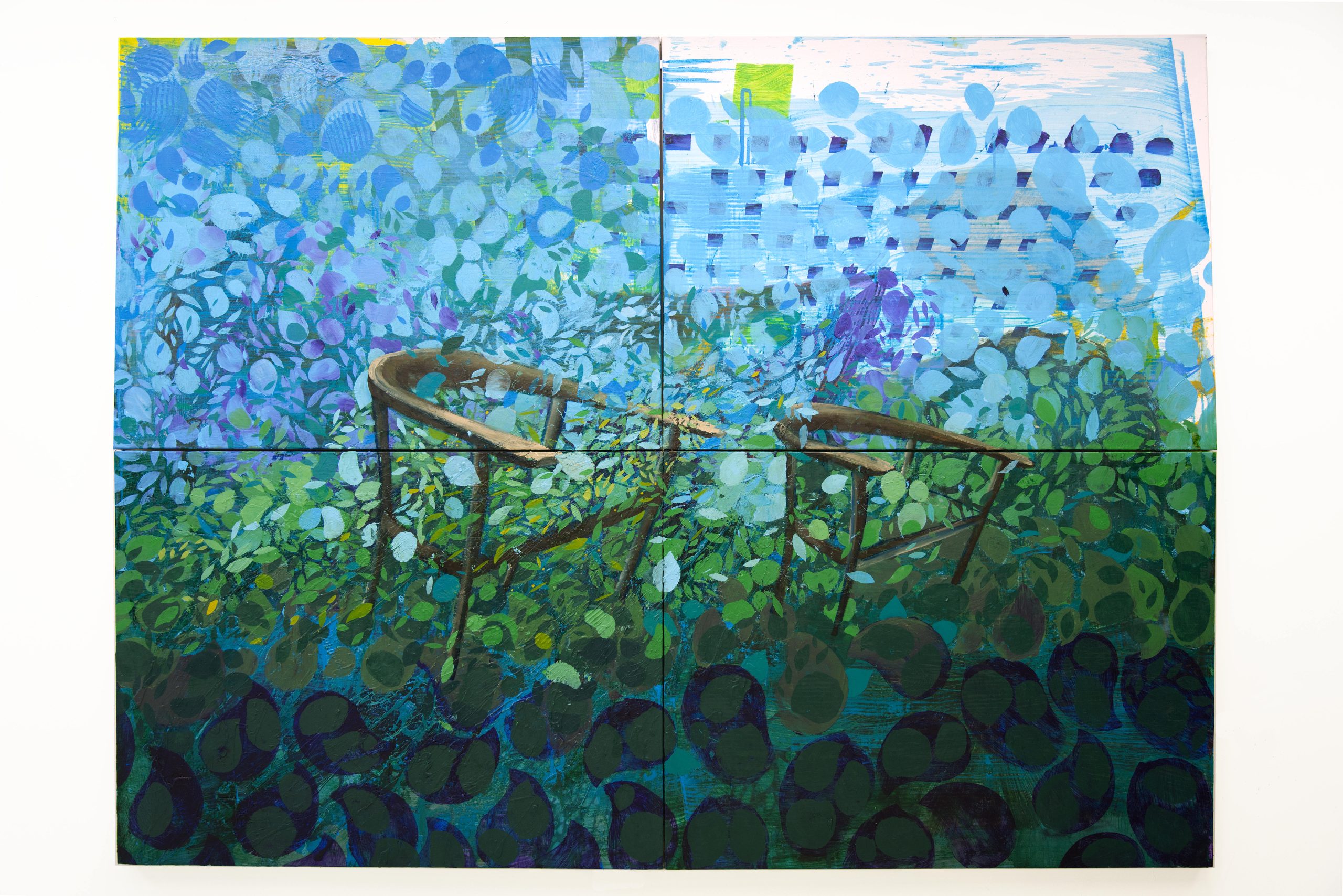
How an Original Painting Gets to Your Door: Packing and Shipping, Step by Step
How an Original Painting Gets to Your Door: Packing and Shipping, Step by Step
From checkout to the wall: how a one-of-a-kind painting is packed by hand, tracked, and received without drama.
You found the painting. You read the description twice, measured your wall, and paid. Then a quieter worry shows up: this thing is one of a kind, and now it has to travel. Trucks, sorting hubs, loading docks, weather. If anything happens on the road, there is no second copy sitting in a warehouse, ready to be sent out as a replacement.
I am Bartosz Beda, a painter working in Dallas, Texas. I sell my original paintings directly through my own online store, and I ship them worldwide. Every painting that leaves my studio is packed by hand, with one rule in mind: pack as if the box will be dropped, because somewhere between my door and yours, it probably will be. This guide walks through the whole journey, step by step, so you know exactly what happens between checkout and the moment the painting hangs on your wall.
A quick word about who is doing the packing. I was born in Poland in 1984, and I have been painting since I was seven years old, when I started by copying my older brother’s drawings. I went to art school in Lodz, then earned an MA in Fine Art from Manchester in 2011. The years since include the Catlin Art Guide and a Saatchi New Sensations shortlist in 2012, a scholarship at the Dresden Academy of Fine Arts, a fellowship at the Fondazione per l’Arte in Rome in 2016, a residency at GoggleWorks in 2018, and the Edwards Trust residency at Angelo State University in 2025. I founded Execute Magazine and the Art Be You Academy, and I wrote a book called Hear My Voice. I list all that for one simple reason: the person who made your painting is the person who packs it. No shipping department ever touches the box.
First, What Kind of Painting Is Traveling?
Shipping starts with the object itself, because a small work on paper and a five-foot canvas are two different packing problems. My store sells originals only, no prints, and the range is wide. Small original works on paper start at $100. The small Mirage paintings are $1,000 and $1,200, the larger ones run $4,000, $7,500, and $10,000, and the biggest canvases reach 60 by 80 inches and $20,000. A $100 study and a $20,000 canvas get the same standard of care, but they do not get the same box. Here is how each kind travels.
Step One: Small Works Travel Flat, Between Rigid Boards
Paper is light, and that is exactly its risk. A work on paper can bend, its corners can fold, and a thin, flexible package invites rough handling. So a small painting of mine never travels loose in a soft envelope, and it never travels rolled and hoping for the best.
First, the work is covered with protective wrap, so nothing touches the painted surface directly. Then it is placed between rigid boards, cut larger than the piece itself, and the boards are secured so the sandwich cannot shift. The boards take the bends, the knocks, and the weight of anything stacked on top. The paper inside stays flat and untouched. The finished package is stiff, flat, and honestly a little boring. Boring is the goal. A package that cannot be folded gives nobody the chance to fold it.
- Protective wrap around the work, so the surface never touches the packaging.
- Rigid boards on both sides, larger than the painting, so it cannot flex or crease.
- A sealed, flat package that stays stiff from my studio to your door.
One more thing about paper: it notices weather. A sealed, stiff package keeps rain, humidity, and dust away from the surface during the trip, including the minutes the box spends sitting in a truck or on a doorstep. By the time you slide the work out from between the boards, it should look exactly as it did on my studio table.
Step Two: Large Canvases Travel in Custom Wooden Crates
A stretched canvas is strong in some ways and fragile in others. The wooden stretcher can take weight, but the painted surface can be punctured, scuffed, or pressed in by anything heavy resting against it. Cardboard is not enough protection for that. So large canvases travel in wooden crates, and each crate is built for the one painting going inside it.
The crate is sized to the painting’s stretcher, so the work sits snug and cannot slide or rattle. Inside, the canvas is wrapped and cushioned, and the surface never rests directly against the wood. Then the crate is closed and reinforced. Out in the world it will meet forklifts, conveyor belts, warehouse floors, and the inside of more than one truck. In my studio, a crate can look like overkill. Halfway through its journey, it looks like the minimum sensible choice.
- A crate built to the exact size of the painting, so nothing shifts in transit.
- Wood that takes impacts cardboard would pass straight through to the canvas.
- Wrapping and cushioning inside, so the painted surface never touches the crate.
Step Three: Every Shipment Is Tracked
People sometimes ask what protects a painting on the road. My honest answer is that the protection is the packing itself, and care at every single step of the delivery. An original painting cannot be reprinted, restocked, or swapped for an identical one, so the job is to make sure it never needs replacing. That means boards that cannot bend, a crate that cannot crush, and a package built to be secure from the moment it leaves my studio to the moment it reaches your hands.
Your shipment also travels with tracking, so you can follow the box as it moves toward you. Tracking is not just peace of mind. It is practical. A painting should not sit on a porch in the rain, or wait in a hot delivery hub longer than it has to. When you can see the delivery coming, you can plan to be there, take the box from the driver, and bring it inside right away.
Why Your Painting Does Not Ship the Same Day
Online shopping has trained everyone to expect a shipping notice within hours. That works when a warehouse worker pulls a finished box off a shelf. My studio is not a warehouse, and there is no shelf of pre-packed paintings waiting for labels.
Each order starts a real packing job. Boards are cut to size. Wrap is measured and fitted. For a large work, a crate is built panel by panel around one specific canvas. I would rather spend the time and send a painting that survives the trip than rush a box out the door and hope the road is kind. When you buy an original, some of what you are paying for is this slowness. Careful work takes the time it takes, and packing is the last place I would ever cut a corner.
Step Four: The Box Arrives at Your Door
Your part in this is short, but it genuinely matters, and it starts before you open anything. Photograph the box or crate from all sides, exactly as it arrived. If there is a dent, a tear, or a crushed corner, those photos are your evidence. They take twenty seconds, and you will probably never need them. Take them anyway.
- Photograph the outside of the package before you open it.
- Open it slowly, and keep all the packing materials for now.
- Inspect the painting in good daylight, checking the surface, corners, and edges.
- For a big crate, have a second person there to help lift the painting out.
Daylight deserves its own sentence. A scuff or pressure mark that hides under warm indoor light can show clearly next to a window. Give the painting one honest look in real light before the boards, wrap, and crate go out with the trash. If everything looks right, you are done with logistics. The rest is the part you actually paid for.
If Something Arrives Damaged
I will be straight with you: damage in transit is uncommon when a painting is packed this way, but no honest seller calls it impossible. If your painting arrives damaged, contact me as soon as you can, and send the photos you took of the box and the work. Report it fast, while the evidence is fresh and the packing is still in your hands.
Keep the box, the boards or crate, and all the packing materials until we have settled what happens next. The package itself is part of the evidence. It shows me how the damage happened and where the packing was tested. It feels untidy to keep a crate standing in your hallway for a while. It is still much better than trying to explain damage with nothing left to show.
Then we settle it between us. Some damage is minor and can be repaired. Serious damage means your money comes back to you. The details depend on the case, but the structure does not: you ordered an original painting in perfect condition, and between the packing and me, the job is to make sure that is what you end up with, or your money comes back to you.
A Note on Worldwide Shipping
I ship worldwide, and distance changes the math. A painting crossing an ocean passes through more hands, more vehicles, more warehouses, and bigger swings in temperature and humidity than a painting crossing Texas. Every extra hand is another chance for a dropped corner or a heavy box stacked where it should not be. That is one more reason large works travel in crates. The packing standard does not drop for a far address. The box is built for the roughest version of the trip, not the average one.
Questions to Ask Any Seller About Shipping
Wherever you buy original art, ask about shipping before the money moves. A serious seller will answer every one of these in a single email:
- How will this specific painting be packed: flat between boards, boxed, or crated?
- Will I be able to track the shipment on its way to me?
- What exactly should I do, step by step, if the painting arrives damaged?
- Are packing and shipping costs included, or should I expect extra charges?
- Does the painting come with a signed certificate of authenticity?
Vague answers are information too. Packing and shipping are not trade secrets. Anyone who ships original paintings regularly has a real process, uses real materials, and can describe both without hesitating. If a seller cannot tell you how your painting will travel, that silence is worth more than any discount.
The Bottom Line
An original painting is the opposite of a mass-produced product, so shipping one is a craft of its own: small works flat between rigid boards, large canvases in custom wooden crates, tracking on the road, and a few careful minutes from you when the box arrives. If you would like to see the paintings themselves, visit my store at store.bartoszbeda.com. Every price is listed openly, every original comes with a signed certificate of authenticity, and every piece ships worldwide, packed as if the box will be dropped. It probably will be. Your painting will be fine anyway.