Buying Art Together: How Two People Choose One Painting Both Love
Most paintings in my store are not bought by a person. They are bought by two people, standing in the same room, looking at the same screen, wanting different things. One wants color. The other wants quiet. One falls for a painting in ten seconds. The other needs a week and still is not sure. Then they write to me, or they argue kindly in my studio, and the argument is always the same at the root: how do two tastes become one wall.
I have watched this negotiation for years, in galleries, in studios, and in collectors’ homes. The couples who end up with paintings they both love are not the ones with identical taste. They are the ones with a fair method. This article is that method: how to shortlist, how to use the veto without abusing it, how to test a painting against the actual wall, how to talk about money honestly, and when the right answer is two smaller paintings instead of one large one.
Start With the Wall, Not With Taste
Arguments about art are usually arguments about the room wearing a disguise. Before either of you opens a single listing, agree on the facts. Which wall. How wide. What hangs near it. What the room is for. Measure the wall and write the target size down. My room by room size guide gives the width rules for the main walls of a house, and agreeing on those numbers first removes half the paintings in the world from the argument, including most of the wrong ones.
Then agree on the job the painting does. A living room painting is public. It is seen by guests, and it sets the room’s tone. A bedroom painting is private and can be stranger. A hallway painting is seen in passing, a hundred times a day, for three seconds at a time. Two people often discover they were shopping for different jobs. Once the job is fixed, taste has something to aim at.
The Shortlist Method
Each person builds a shortlist alone. Five paintings each, no discussion during the search. Solitude matters here. In a shared search, the faster talker leads, and the quieter taste never gets fully formed. Alone, each of you finds out what you actually like, which is often a surprise to both.
Then exchange lists and look for the overlap. There is almost always one painting both people saved independently, or two paintings from the same series. Start there. If there is no overlap at all, look one level up. Not the same painting, but the same qualities: the same darkness, the same kind of figure, the same temperature of color. Taste rarely matches at the level of the individual work. It matches at the level of what the work does.
Rank the shared candidates together, out loud, with reasons. Not I like it. Reasons. It is calm without being empty. The figure feels like someone thinking. The blue will hold the rug. Reasons can be answered. Preferences can only collide. My guide to choosing abstract figurative art gives a shared vocabulary for this: how to talk about a figure, a field, and a surface without either person needing an art degree.
When One of You Wants a Figure and the Other Wants Pure Abstraction
This is the most common split I see, and it looks like a deadlock. One person wants a painting with a figure in it, something human to meet. The other finds faces distracting and wants pure color and shape. Neither is wrong. They are asking the painting for different kinds of company.
The middle ground is real, and it has a name: abstract figurative painting. In it, the figure is present but never fully described. A head may dissolve into the field around it. A body may be three strokes and a shadow. The person who wants a figure gets one, standing in the work, giving it a pulse. The person who wants abstraction gets a painting that never stops being paint. Neither has to surrender.
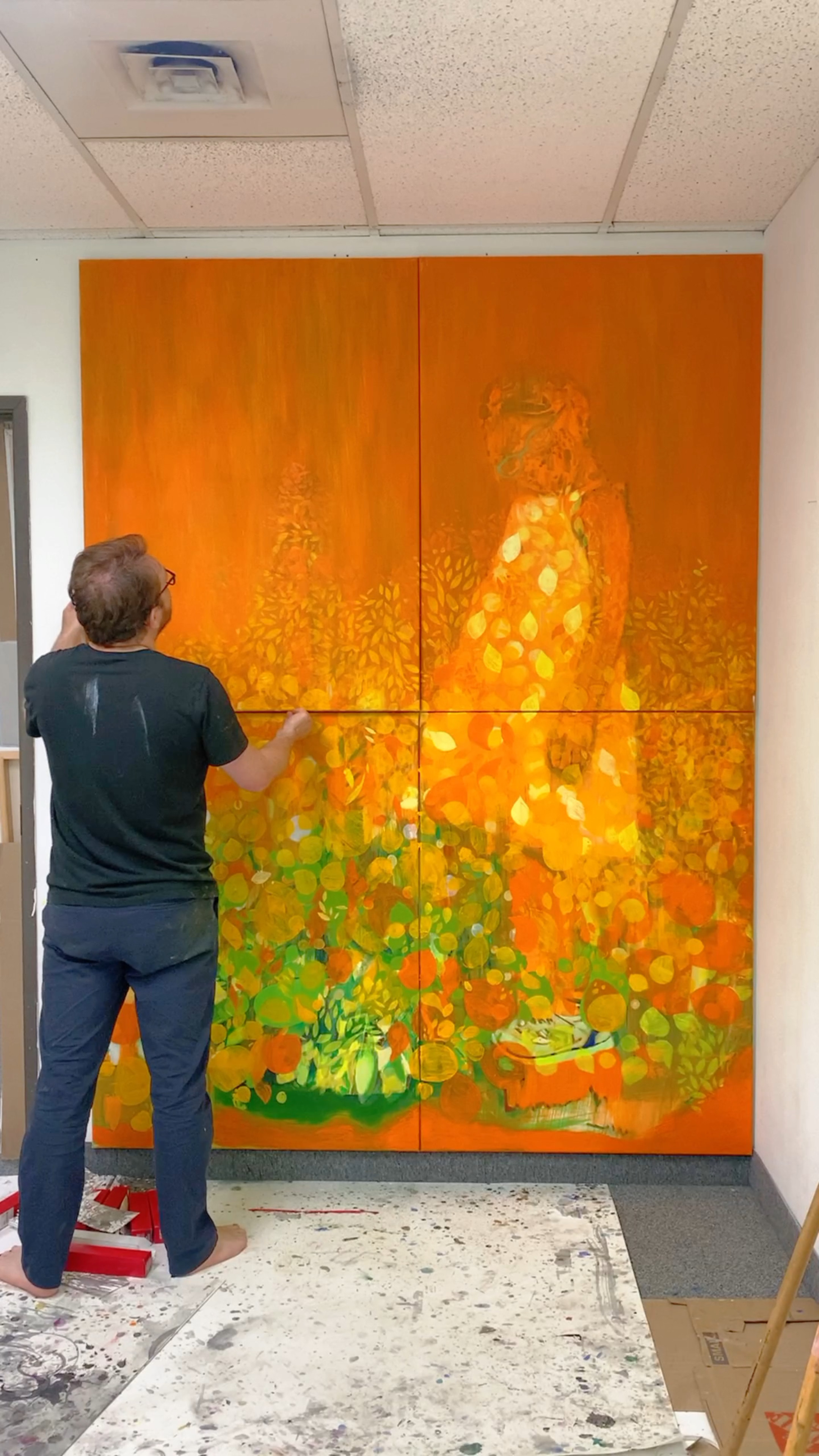
Judge candidates on the ratio. Some abstract figurative works are ninety percent figure. Some are ninety percent field, with the figure barely surfacing. Two people who disagree about figures usually agree about the ratio once they see three or four examples side by side, which is another reason the shortlist works. My own Mirage paintings sit in the middle of that range: the figures stand in wide fields of light, clear from across the room, dissolving as you come close. That double behavior is exactly what divided couples end up choosing, more often than either pure camp.
The Veto Rule, and How Not to Abuse It
Every joint purchase needs one clear rule, agreed before the shortlist exists. Here is the rule that works. Either person can veto any painting, without having to justify it, but a veto is spent carefully and a veto is not a counter offer. The veto protects the person who will hate living with the piece. It does not entitle anyone to push their own favorite through.
Why no justification. Because the deepest reactions to paintings are real before they are verbal. A painting can stir something a person cannot explain in the moment, grief, a memory, a room from childhood. Forcing an explanation turns a feeling into a debate, and debates have winners. A home should not be decorated by verdict.
But the veto has a limit. If one person vetoes everything, the method stops, and the problem is no longer taste. It is usually money fear, or a wall neither person actually wants to fill, or one person shopping for a different room in their head. Name that honestly and solve the real problem first. The paintings will still be there.
The Tape Test, Together
When the shortlist is down to one or two, test the painting against the wall before anyone pays. Tape the outline at full size with painter’s tape. Then both of you live with the outline for two full days. Not one evening. Two days, with morning light and lamplight, and the ordinary traffic of the room.
Watch what happens. Most couples find the size argument ends here, because the wall votes. An outline that felt large on a screen feels right in the room, or the reverse. If you disagree about size after the tape, take the larger size. In fifteen years I have never had a collector write to say the painting was too big. Too small arrives in my inbox every season. My guide to buying a large painting covers the practical checks that follow: doorways, wall strength, and delivery.
Money: The Honest Conversation
Set the budget together before the shortlist, as a range, not a single number. A range lets a painting that is slightly above the middle win on merit. A single hard number turns every candidate into a negotiation about the number.
Then say the quiet part out loud. A painting is not an investment first. It is a piece of your daily life that may hold value. Two people who secretly disagree about that will fight about every price. One is buying furniture. The other is buying an asset. Agree that the painting must earn its place on the wall first, and let value be a welcome second. My honest guide to what original paintings cost explains how prices are built, which helps both people see the same number the same way.
If the budget truly cannot reach the painting you both love, do not buy the cheaper painting neither of you wanted. Buy a smaller work by the same artist, or a work on paper, and keep the wall’s ambition alive. Or buy a canvas print of the loved painting for now and the original later. My article on canvas prints for big walls explains when that trade is wise. A compromise painting that both people settled for is the most expensive kind. It costs the money and gives back nothing.
When to Buy Two Instead
Sometimes the shortlist ends in a fair tie: your painting and theirs, both strong, neither vetoed, no overlap. That is not a failure of the method. It is the method reporting that this house has two tastes, and the answer is two paintings.
Two smaller works instead of one large one. Yours in the room you use most. Theirs in theirs. Or the two hung as a pair in one room, where the conversation between them becomes the room’s interest. Works from the same series make this easiest, because the artist has already done the harmonizing. My article on painting series explains how bodies of work are built to hang together, and how collectors assemble pairs over time.
There is a third shape as well. One painting now, the second on a date. An anniversary, a finished renovation, a moved house. Couples who collect this way build the most personal walls I see, because every piece on them has an occasion attached.

The Other People in the House
Two people rarely decorate alone. Children have opinions earlier than parents expect, and a painting a child grows up with becomes part of that child’s memory of home. You do not need a child’s vote on a living room painting. But if a child keeps returning to one candidate on the screen, that is data. Children read figures honestly, without the fear of choosing wrong that adults bring.
Parents and in-laws are the opposite case. Their taste arrives with authority it has not earned in your house. Listen politely. Then remember whose mornings the painting will start. Inherited paintings complicate this further. A work that came from family carries a duty to hang it somewhere, but not a duty to hang it on the main wall. The second wall, the hallway, the study: all honorable places. The wall above your own sofa belongs to the people who sit under it every day.
A Last Word From the Studio
I never try to close this argument when it happens in front of me. A painting chosen to end a disagreement will remind both people of the disagreement. A painting chosen by a fair method, at the size the wall asked for, inside a budget both people said out loud, becomes something else. It becomes the first thing the two of you made together in that room.
Start with the wall. Build your lists alone. Protect the veto. Let the tape decide the size. And if the answer turns out to be two paintings, believe it. The collections in this store are organized by series to make the shortlist easier: Mirage for desert light and standing figures, Echoes of Seasons for the large canvases, Owing to the Absence for ink on paper. Make your five. Compare them tonight. The wall is waiting.