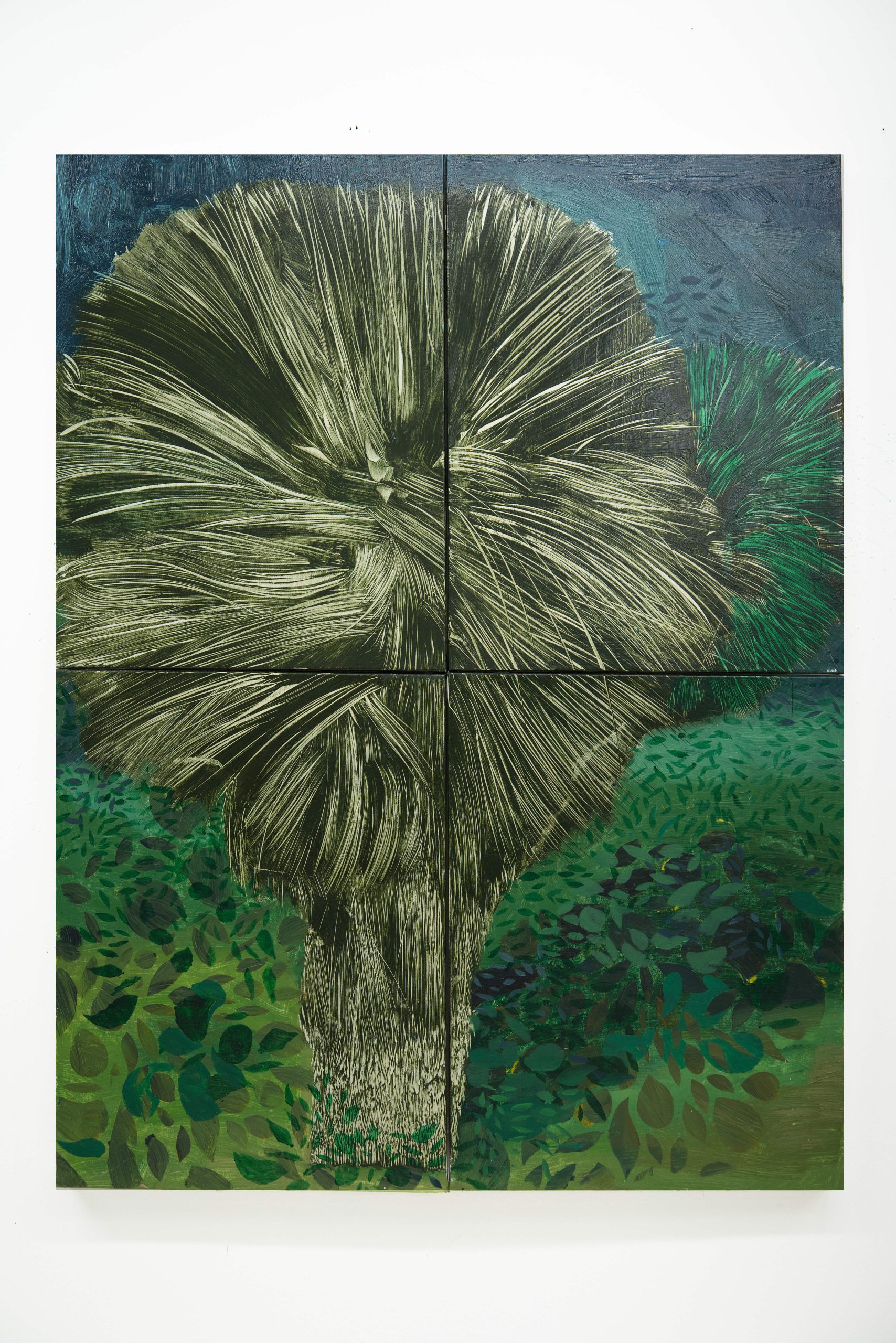
How High to Hang a Painting: The Heights and Spacing Rules That Work
Six inches too high and a good painting looks lost. Here are the measurements galleries use, translated for real rooms and real walls.
More good paintings are ruined by height than by anything else. The painting is right. The wall is right. Then it goes up a hand too high, or a foot too low, and the whole room feels slightly off without anyone knowing why. Hanging height is not a matter of taste. It is a matter of where human eyes actually rest, and there are measurements for it. This article is those measurements, the same ones I give buyers who take one of my paintings home.
I am Bartosz Beda, a painter working in Dallas, Texas. I trained at art school in Lodz and earned my BA in 2011 and my MA in Fine Art from Manchester in 2012. I sell my original paintings directly through my own store, and I have hung more exhibitions than I can count, in galleries and in collectors’ homes. Every rule below is one I use myself, with a tape measure, not a theory.
The Center Rule: 57 to 60 Inches
Here is the rule everything else hangs on. A painting should be centered at eye level, and eye level for most adults, standing, falls between 57 and 60 inches from the floor. Galleries and museums hang to this line so consistently that the center of almost every painting in a good exhibition sits in that band. It works because the painting meets your eyes instead of making your eyes travel up or down to meet it.
The measurement is to the center of the painting, not the top and not the bottom. The math takes ten seconds. Measure the painting’s height. Divide by two. Measure down from the top of the painting to the point where the wire or hook will catch, if it hangs from a wire. Then place the hook at 58 inches, plus half the painting’s height, minus that wire distance. If the painting hangs from fixed hardware on the back, the hook point is simpler: 58 inches plus half the height puts the center on the line.
- Single painting on an open wall: center at 57 to 60 inches from the floor.
- Measure to the center of the work, never to the top edge.
- If two people in the home differ a lot in height, split the difference. The band is forgiving.
- In a room where people mostly sit, like a dining room, the lower end of the band feels better.
Above a Sofa or Furniture, the Rule Changes
The center rule assumes an open wall. The moment a painting hangs above furniture, the furniture takes over the geometry. The painting now belongs to the sofa, the console, or the headboard below it, and it should be hung in relation to them, not to the room’s eye level. The bottom edge of the painting should sit about 6 to 8 inches above the top of the furniture. Higher than that, the painting floats away and looks disconnected. Lower, and it crowds the furniture and risks heads and cushions.
Width matters as much as height here. A painting above a sofa should span roughly two thirds of the sofa’s width. Much narrower and it looks like a postage stamp on a letter. Much wider and it swallows the furniture. If one painting cannot reach two thirds, a pair or a group can, and then the group is measured as one unit, with its combined width doing the job. My room-by-room size guide goes through the widths for each kind of wall, and it is worth reading before you choose the piece, not after.
Pairs and Groups: One Picture, Small Gaps
A group of paintings is hung as a single composition. First decide the group’s outer edges, as if the whole arrangement were one big painting. Center that whole block on the wall using the same eye-level rule. Then keep the gaps between pieces small and even: 2 to 3 inches between frames is the range that reads as intentional. Wider gaps make the pieces drift apart into separate, lonely objects. Uneven gaps look like an accident no matter how good the paintings are.
The order that works: lay the group on the floor first, in front of the wall. Photograph it. Live with the arrangement for an hour. Then tape each piece’s outline on the wall with painter’s tape, step back, and only then drill. The tape stage feels slow. It is still faster than filling holes.
- Treat the group as one picture. Center the whole block, not each piece.
- Keep gaps at 2 to 3 inches, and keep them identical across the group.
- Build the arrangement on the floor and photograph it before anything touches the wall.
- Hang the largest piece first, then place the rest against it.
Stairs, Hallways, and Other Awkward Walls
A stairwell wall follows the slope, not the floor. Measure the eye-level line from the steps themselves: stand on a step, mark roughly 58 inches above that step’s tread, and let the center of the painting or the line of a group follow the angle of the staircase. A row of pieces marching up a stair wall at one level height looks wrong, because nobody views them from one level place.
Hallways are viewed close and in passing, so smaller work can hang a touch lower than the standard band, where it meets the eye of someone walking by rather than standing back. In narrow halls, also mind the depth of frames. A deep frame in a tight hallway is a shoulder magnet, and a painting that gets brushed weekly will not thank you. Flat works and works on paper, framed close to the wall, behave best there.
Big Paintings: Height Is Only Half the Job
Everything above still applies to a large painting, with one addition: weight decides the hardware before height decides the hook. A large canvas needs its load carried by studs or by anchors rated well above its weight, and wide pieces need two fixing points so they hang level and stay level. Get that wrong and the most perfectly measured painting in the world ends up tilted, or on the floor. My checklist for buying a large painting covers the weight, wall, and route questions in full, and it is the right read before a big piece arrives, not after.
Light deserves one sentence in a hanging article, because height and light interact. A painting hung high under a ceiling light can catch glare across its top half all evening. Before the final hole goes in, check the wall at the hour the room is actually used, and read the light the painting will live in. My care guide covers what light does to a painting over years, and why the soft, indirect wall is the kind one.
Tall Ceilings, Low Ceilings, and Small Rooms
The eye-level band assumes a normal room. Very tall ceilings tempt people to hang high, to fill the space. Resist it. A painting hung at the center rule on a tall wall still works, because people look at paintings, not at the empty wall above them. The space above the painting is not a problem to solve. If the wall truly needs more, the answer is a larger painting or a vertical group, not a higher hook.
Low ceilings and small rooms pull the other way. A big piece can hang slightly lower than the band, closer to 57 inches, so its top edge keeps a comfortable distance from the ceiling. What matters is that the painting keeps breathing room on every side. A canvas that nearly touches the ceiling and the sofa at once will feel like it is being squeezed by the room, whatever the tape measure says.
What You Actually Need in the Toolbox
- A tape measure and a pencil. Every measurement in this article is pencil work before it is drill work.
- Painter’s tape, for outlines you can live with for a day before committing.
- A level. Wide paintings announce a tilt to the whole room.
- Hooks and anchors rated above the painting’s weight, and a stud finder for anything large.
- A second pair of hands for anything wider than your own arm span. Big canvases are awkward, not heavy, and awkward is how corners get dented.
None of this is specialist equipment, and the whole list costs less than one wrong hole in a plaster wall. The one tool that does not exist is a shortcut around measuring. Every crooked, floating, or lost-looking painting I have ever been asked about came down to the same thing: somebody eyeballed it.
The Mistakes I See Most Often
- Hung by the top edge. Someone measures 60 inches to the top of the frame, and the painting’s center ends up near the ceiling.
- Hung for the tallest person in the house. Everyone else spends years looking up at it.
- One small painting alone on a huge wall at perfect height. The height is right and it still looks lost. The piece is too small for the wall, and no hook position fixes that.
- A group with random gaps. Three inches here, seven there. The eye reads the gaps before it reads the art.
- Drilled first, taped never. Every wrong hole in a wall I have ever seen came from skipping the tape outline.
The Bottom Line
Hang to the center, at 57 to 60 inches on an open wall. Drop to 6 to 8 inches above the furniture when furniture is involved. Treat groups as one picture with 2 to 3 inch gaps. Follow the slope on stairs, tape everything before you drill, and let weight choose the hardware on big pieces. That is the whole craft, and it takes one afternoon to learn for life. If you are choosing the painting itself, the originals in my store are listed with exact dimensions on every page, at store.bartoszbeda.com, so the measuring can start before the box even ships.